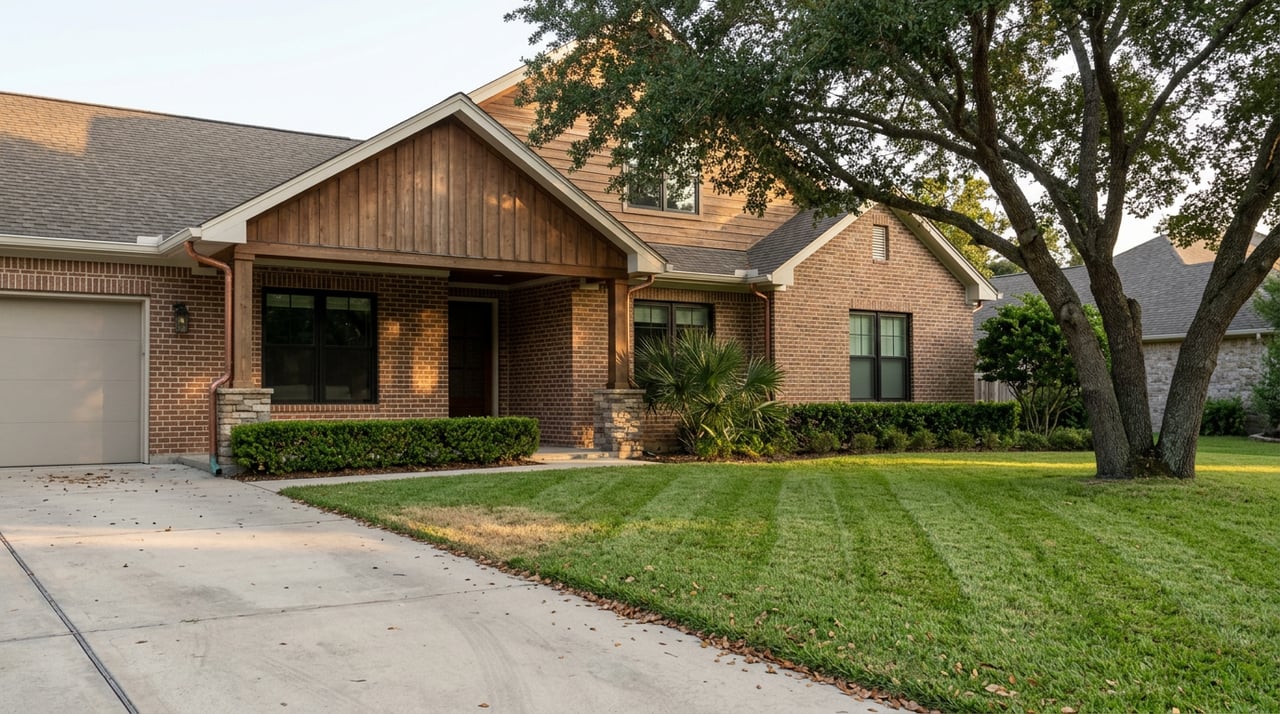
Which is the better deal: a new-construction home priced in the $400s in a Fort Bend County community that broke ground in 2025, or a similarly priced resale in a Sugar Land neighborhood that has been selling houses since the early 1990s?
Most buyers answer that question by comparing square footage and finish-out. The number that actually decides it sits a few lines down the tax bill, in a district most people don't think to ask about until the option period: the Municipal Utility District, and how far along that district is in paying off the debt that built its water lines, roads and drainage.
The Community Name Doesn't Tell You the Bill
Here's the part that surprises even buyers who've done their homework on MUDs: living in an established, decades-old master-planned community does not guarantee an established, low MUD rate. It depends on which specific district number covers your lot, not the marketing name on the entry monument.
Sienna, the Missouri City community Johnson Development has built out since the 1990s, is a clean example of why. According to the Fort Bend County Tax Assessor-Collector's office, Sienna MUD 2 has been annexed by the City of Missouri City and no longer appears as a current-year tax line at all. That district finished its job and disappeared from the bill. Meanwhile, a bond disclosure document filed for Sienna Municipal Utility District No. 7 shows the district sold $1.95 million in unlimited tax bonds and $2 million in road bonds in October 2025, on top of a Sienna Master District that already carried $86.3 million in outstanding contract revenue bonds and planned to issue $17 million more that same month.
Same community name. One district already off the books. One district borrowing fresh money as recently as ten months ago.
A house two streets apart in the same Fort Bend County community can sit in a MUD with no more debt to retire, or a MUD that just went back to the bond market.
That is the fact a listing sheet won't show you, and it is the reason "how long has this community existed" is the wrong question. The right one is "which MUD number is on this specific lot, and what does its debt schedule look like."
What "Brand New" Actually Means Right Now
Fort Bend County has four master-planned communities moving through this exact starting phase in 2026, which makes the mechanism easy to see in real time rather than in an old bond filing.
Evergrove, a 1,655-home community from Toll Brothers and Tri Pointe Homes, is under construction on 911 acres off FM 723 near Richmond, with pricing expected to run from the $400s past $1 million, according to an April 2026 KHOU report. The George, Johnson Development's ninth Fort Bend community, sits on 1,500 acres off FM 2977 and Koeblen Road, with eight builders including Chesmar, Perry Homes and David Weekley building the first 270 homesites, zoned to Lamar CISD behind the district's Randle High School, according to Covering Katy News. Indigo, a 235-acre "agrihood" in Richmond where residents began moving in earlier this year as part of a Texas A&M health study, dedicates 42 acres to working farmland, per Community Impact's May 2026 coverage. And near Beasley in western Fort Bend County, League City-based Windy Hill Development is entitling 318 acres for a 1,000-home community and, as of a February 2026 KHOU story, is still in the process of setting up the municipal utility district that will eventually tax those homes.
That last detail is worth sitting with. The Beasley community doesn't have a MUD rate yet because the district hasn't finished forming. Whatever rate it opens with, once bonds are sold to build the water, sewer and drainage system, will be the starting point on a curve that only comes down slowly from there.
The Math Buyers Skip
Fort Bend County's own tax data gives a sense of the spread between a district near the end of its debt and one near the beginning. A 2025 rate cited for Fort Bend County MUD No. 81, which serves the established Weston Lakes community, came in at $0.361 per $100 of assessed value. Multiple current sources on Fort Bend tax structure put established, largely-retired MUDs in the $0.17 to $0.36 range, while newer districts still carrying heavy infrastructure debt can run past $1.00 per $100.
Run that spread against a $450,000 home. At $0.36 per $100, the MUD line adds $1,620 a year. At $1.00 per $100, it adds $4,500. That's a $2,880 annual gap, or roughly $240 a month, from the MUD line alone, before county, school district or city rates even enter the picture.
The part that catches buyers off guard isn't the size of that gap. It's how long it lasts. MUD rates generally decline only $0.05 to $0.15 per $100 over a period of years as bonds get retired, which means a buyer who purchases into a $1.00-plus rate today should not expect that number to approach a mature district's $0.36 within a typical seven-to-ten-year hold. The historical opening rate for Cross Creek Ranch's MUD portion in Fulshear, back in 2016, ran between $1.12 and $1.34 per $100. That's a useful data point precisely because it's old: it shows what a new district's first years actually look like, and how much runway a homeowner needs before that number meaningfully closes the gap with a place like Sugar Land's First Colony, where most MUD bonds have been retired and the total tax rate now runs closer to 2.55 to 2.65 percent.
None of this means new construction is a bad move. It means the price tag on the sign isn't the price tag on your mortgage escrow.
Four Things to Check Before You Compare Two Communities
- Get the specific MUD number, not just the community name. Look it up on the Fort Bend Central Appraisal District's tax rate page, since a single community can contain districts at completely different stages of debt.
- Ask whether the district has issued bonds recently. A district that sold bonds in the last year or two is still early in its curve, regardless of how long the surrounding community has existed.
- Ask for the combined rate, not the headline number. County, school district, city and MUD taxes all stack on the same bill, and the MUD line is often the one left out of a builder's affordability worksheet.
- Model the total monthly payment, not just principal and interest. A $240 monthly swing in MUD tax changes what a $450,000 home actually costs to carry, and it belongs in the same conversation as the interest rate.
A Few Questions Worth Asking Directly
Does a MUD tax ever go away completely? It can, once the bonds are fully retired or if a city annexes the district, as happened with Sienna MUD 2. Annexation only helps your wallet if the city's own rate is lower than what you were paying combined, so it's worth comparing both numbers rather than assuming annexation is automatically good news.
Will my new-construction MUD rate definitely drop over time? Only if the district stops issuing new bonds. Sienna MUD 7's October 2025 bond sale is a reminder that later phases of an otherwise mature community can still borrow fresh money, which resets the clock for homeowners in that specific district.
Comparing a new build in Evergrove or The George against a resale in an established Fort Bend County neighborhood is a reasonable way to shop. Just make sure the comparison includes the one number that doesn't show up on the flyer.
If you're weighing a new-construction lot against an established neighborhood anywhere in Fort Bend County, Shad Bogany can pull the specific MUD numbers on the properties you're comparing and walk through what each one actually costs to carry. Schedule a Free Home Consultation to get the real numbers before you write an offer.